NEPAL’S HAPPY HOUSE: SMH traveller
IN THIS SERIES, MY HAPPY PLACE, OUR WRITERS REFLECT ON THE DESTINATIONS THAT THEY CHERISH MOST.
I suspected Phaplu might be a little outside the ordinary when a man in knickerbockers, knee-high purple socks and a Panama hat stepped off the helicopter onto the airstrip ahead of me. He looked less like someone arriving in a remote Nepalese village, and more like someone en route to a champagne reception at some fabulous alpine club.
As the rotor blades slowed in the bright mountain air, goosebumps rippled across my skin – and not just because of the cold. If this unusually dressed arrival was any kind of omen, the valley surrounding Phaplu might indeed be a beyul, a hidden sacred refuge that locals say reveals itself only when both the time and the traveller are right.
As it turned out, the man was a longtime caretaker of The Happy House, the mountain lodge I stayed in during this first visit to Phaplu, and where I’ve continued to return. Following him up a cobbled path fringed with prayer flags and Himalayan pines, I caught my first glimpse of the stacked-stone Sherpa house ahead and immediately sensed it would live up to its reputation.
I had, after all, come here on the promise that this was no ordinary Himalayan stopover. Sir Edmund Hillary stayed in this house during some of his Everest expeditions. The Italian Count Guido Monzino, along with his 6000 porters, also passed through on their way to summit Everest (the Edwardian gambling table they hauled into the mountains still sits in the living room). Ever since, the house has attracted an eclectic stream of visitors, from actor Richard Gere to British explorer Levison Wood. And yet, it still feels wonderfully under the radar.
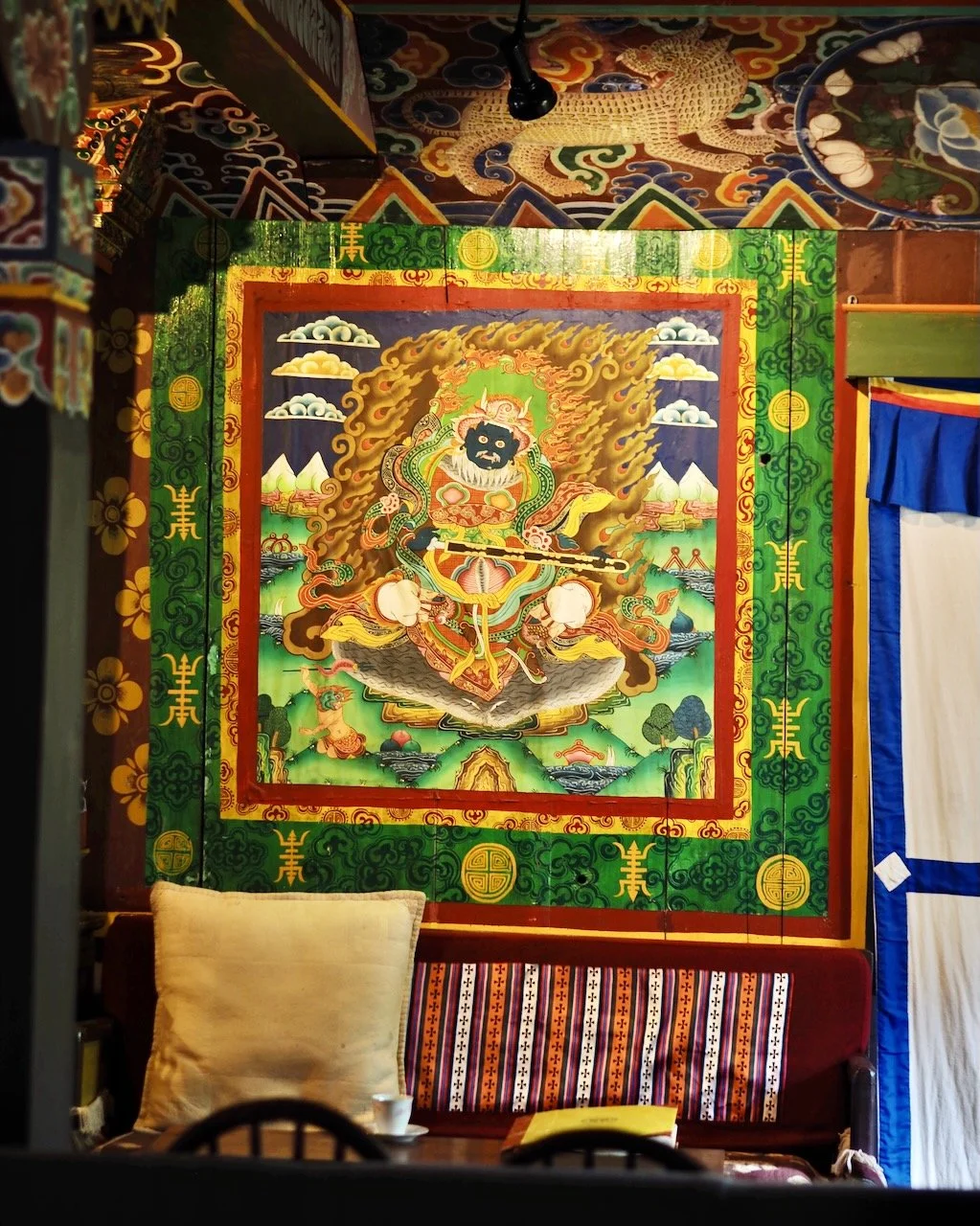
Inside, hand-painted Buddhist thangka paintings cover the walls, bowls of fresh rhododendrons sit on low wooden tables beside flickering butter lamps, and hand-woven Tibetan curtains frame the doorways. But it’s what lies beyond the front door that keeps drawing me back.
Often bypassed in the race toward Everest, Phaplu sits in a far more unhurried corner of Nepal’s Solu Khumbu region, the heartland of the Sherpa people. Which means that each time I take the steep three-hour hike up to Chiwong monastery, what strikes me most is what I don’t encounter: no puffing tour groups, no Bluetooth speakers, no selfie queues. Just local women gathering firewood or grasses in their woven doko baskets, and the occasional rosy-cheeked child offering a shy namaste. In a region famous for bucket lists and summit fever, Phaplu plays an entirely different game. And that is precisely why I keep coming back.
It’s also why I’m drawn higher into the hills above the village, to hike and camp near what locals call the Magic Forest, thick with moss, rhododendrons and wild raspberry brambles. By late afternoon, we emerge onto one of the high clearings. My favourite is a narrow grassy ridge with long, folding views towards the higher Himalayas. Camp is unexpectedly comfortable: padded tents, steaming mugs of hot chocolate appearing at exactly the right moment, and three-course dinners served under an enormous sweep of sky.
You’re not pressed up against the famous peaks here. At dawn, Everest sometimes reveals itself in the distance. But up on this ridge, wrapped in the spacious calm the Sherpas describe as part of the valley’s magic, I’ve never found myself wishing to be any closer.
There is relief in that remove, a loosening of expectations that feels entirely in keeping with the mountains, where plans are suggestions at best. Weather shifts without warning, flights are cancelled, and trails take you in directions you hadn’t anticipated. The mountains are indifferent to schedules. Slowly, you adjust. Over time, I’ve found a softer version of myself here – one less intent on steering, and more willing to follow.
On longer visits, I make time for the full-day hike to Thupten Chöling, one of the region’s great monastic centres, home to several hundred monks and nuns. During the puja (the daily Buddhist prayer ritual), the vast assembly hall fills with rolling drums, the blare of long Tibetan dungchen horns and the clear chime of hand bells echoing off the mural-covered walls. The sound swells, then dissolves into silence, a reminder that nothing is meant to last.
Usually, though, I’m back inside The Happy House by late afternoon, where the fire is already crackling and boots have begun to gather by the door. Mist fills the valley outside the windows, as cups of tea and glasses of wine appear, and conversation flows in the easy way it tends to in the mountains. It’s at this moment, as evening blurs the far peaks into watercolour, that Phaplu feels most like a refuge – one that reveals itself again, only when I’m ready for it.
This story first appeared in print and online here.