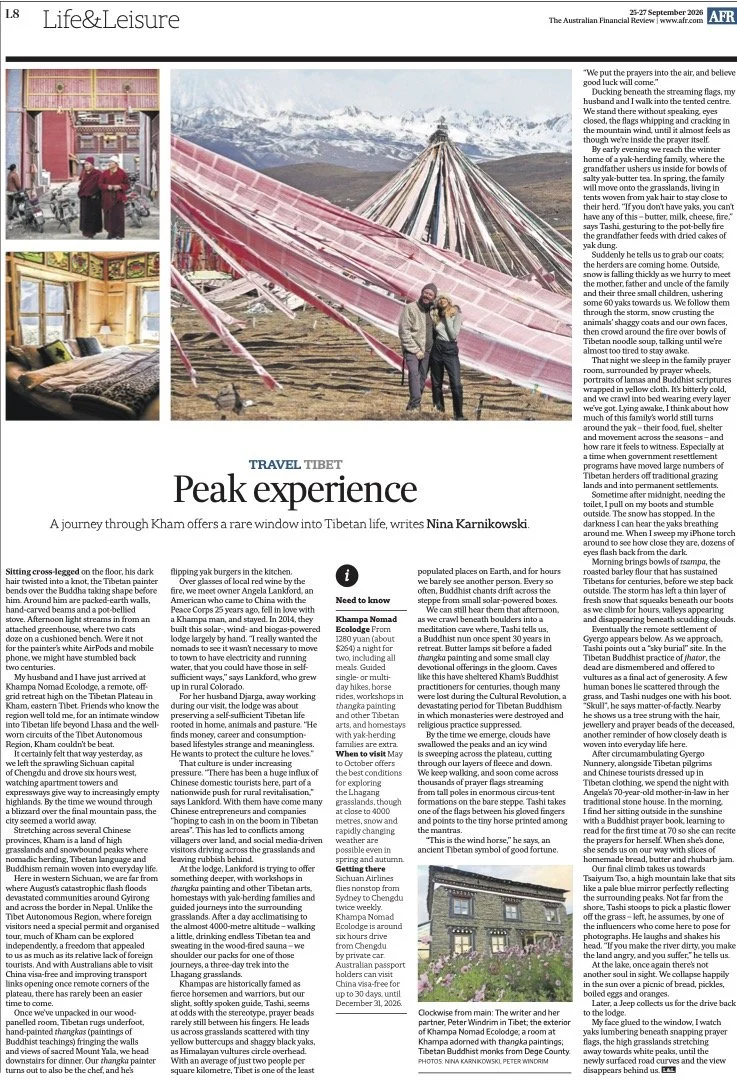
OFF-GRID TREK ON THE TIBETAN PLATEAU: LIFE & LEISURE
A JOURNEY THROUGH KHAM OFFERS A RARE WINDOW INTO TIBETAN LIFE, WRITES NINA KARNIKOWSKI.
Sitting cross-legged on the floor, his dark hair twisted into a knot, the Tibetan painter bends over the Buddha taking shape before him. Around him are packed-earth walls, hand-carved beams and a pot-bellied stove. Afternoon light streams in from an attached greenhouse, where two cats doze on a cushioned bench. Were it not for the painter’s white AirPods and mobile phone, we might have stumbled back two centuries.
My husband and I have just arrived at Khampa Nomad Ecolodge, a remote, off-grid retreat high on the Tibetan Plateau in Kham, eastern Tibet. Friends who know the region well told me, for an intimate window into Tibetan life beyond Lhasa and the well-worn circuits of the Tibet Autonomous Region, Kham couldn’t be beat.
It certainly felt that way yesterday, as we left the sprawling Sichuan capital of Chengdu and drove six hours west, watching apartment towers and expressways give way to increasingly empty highlands. By the time we wound through a blizzard over the final mountain pass, the city seemed a world away.
Stretching across several Chinese provinces, Kham is a land of high grasslands and snowbound peaks where nomadic herding, Tibetan language and Buddhist remain woven into everyday life.
Here is western Sichuan, we are far from where August’s catastrophic flash floods devastated communities around Gyirong and across the border in Nepal. Unlike the Tibet Autonomous Region, where foreign visitors need a special permit and organised tour, much of Kham can be explored independently, a freedom that appealed to us as much as its relative lack of foreign tourists. And with Australians able to visit China visa-free and improving transport links opening once remote corners of the plateau, there has rarely been an easier time to come.
Once we’ve unpacked in our wood-panelled room, Tibetan rugs underfoot, hand-painted thangkas (paintings of Buddhist deities and teachings) fringing the walls and views of sacred Mount Yala, we head downstairs for dinner. Our thangka painter turns out to also be the chef, and he’s flipping yak burgers in the kitchen.
Over glasses of local red wine by the fire, we meet owner Angela Lankford, an American who came to China with the Peace Corps 25 years ago, fell in love with a Khampa man, and stayed. In 2014, they built this solar-, wind- and biogas-powered lodge largely by hand. “I really wanted the nomads to see it wasn’t necessary to move to town to have electricity and running water, that you could have those in self-sufficient ways,” says Lankford, who grew up in rural Colorado.
For her husband Djarga, away working during our visit, the lodge was about preserving a self-sufficient Tibetan life rooted in home, animals and pasture. “He finds money, career and consumption-based lifestyles strange and meaningless. He wants to protect the culture he loves.”
That culture is coming under increasing pressure. "There has been a huge influx of Chinese domestic tourists here, as a part of a nationwide push for rural revitalization,” says Lankford. With them have come many Chinese entrepreneurs and companies “hoping to cash in on the boom in Tibetan areas.” This has led to conflicts among villagers and families over land, and social media-driven visitors driving across the grasslands and leaving rubbish behind.
At the lodge. Lankford is trying to offer something deeper, with workshops in thangka painting and other Tibetan arts. homestays with yak-herding familles and guided journeys into the surrounding grasslands. After a day acclimatising to the almost 4000-metre altitude - walking a little, drinking endless Tibetan tea and sweating in the wood-fired sauna - we shoulder our packs for one of those journeys, a three-day trek into the Lhagang grasslands.
Khampas are historically famed as fierce horsemen and warriors, but our slight, softly spoken guide, Tashi, seems at odds with the stereotype, prayer beads rarely still between his fingers. He leads us across grasslands scattered with tiny yellow buttercups and shaggy black yaks, as Himalayan vultures circle overhead. With an average of just two people per square kilometre, Tibet is one of the least populated places on Earth, and for hours we barely see another person. Every so often, Buddhist chants drift across the steppe from small solar-powered boxes.
We can still hear them that afternoon, as we crawl beneath boulders into a meditation cave where, Tashi tells us, a Buddhist nun once spent 30 years in retreat. Butter lamps sit before a faded thangka painting and some small clay devotional offerings in the gloom. Caves like this have sheltered Kham’s Buddhist practitioners for centuries, though many were lost during the Cultural Revolution, a devastating period for Tibetan Buddhism in which monasteries were destroyed and religious practice suppressed.
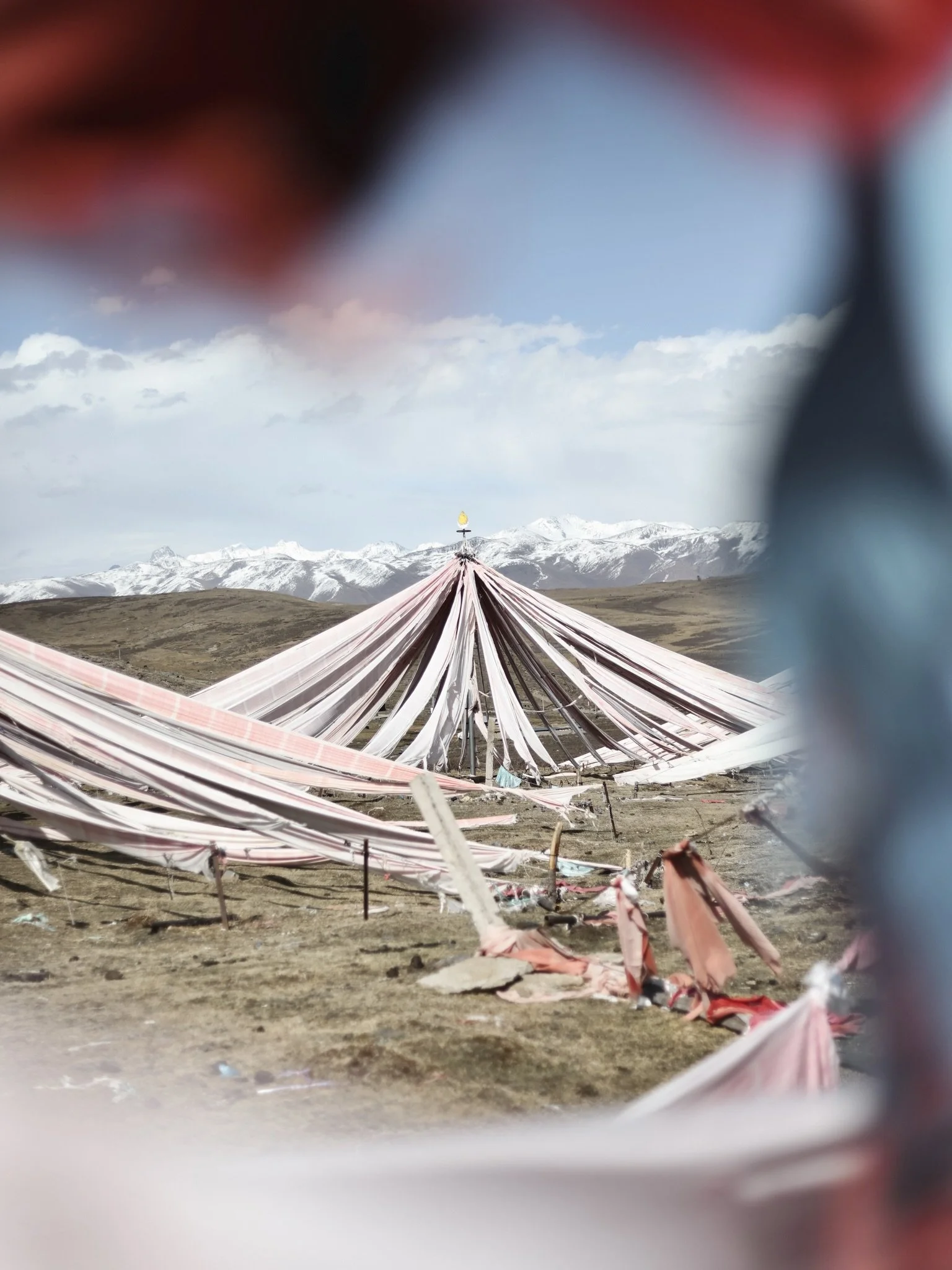
By the time we emerge, clouds have swallowed the peaks and an icy wind is sweeping across the plateau, cutting through our layers of fleece and down. We keep walking, and soon come across thousands of prayer flags streaming from tall poles in enormous circus-tent formations on the bare steppe. Tashi takes one of the flags between his gloved fingers and points to the tiny horse printed among the mantras.
“This is the wind horse,” he says, an ancient Tibetan symbol of good fortune. “We put the prayers into the air, and believe good luck will come.”
Ducking beneath the streaming flags, my husband and I walk into the tented centre. We stand there without speaking, eyes closed, the flags whipping and cracking in the mountain wind, until it almost feels as though we’re inside the prayer itself.
By early evening we reach the winter home of a yak-herding family, where the grandfather ushers us inside for bowls of salty yak-butter tea. In spring, the family will move onto the grasslands, living in tents woven from yak hair to stay close to their herd. “If you don’t have yaks, you can’t have any of this - butter, milk, cheese, fire,” says Tashi, gesturing to the pot-belly fire the grandfather feeds with dried cakes of yak dung.
Suddenly he tells us to grab our coats; the herders are coming home. Outside, snow is falling thickly as we hurry to meet the mother, father and uncle of the family and their three small children, ushering some 60 yaks towards us. We follow them through the storm, snow crusting the animals’ shaggy coats and our own faces, then crowd around the fire over steaming bowls of Tibetan noodle soup, talking until we’re almost too tired to stay awake.
That night we sleep in the family prayer room, surrounded by prayer wheels, portraits of lamas and Buddhist scriptures wrapped in yellow cloth. It’s bitterly cold, and we crawl into bed wearing every layer we’ve got. Lying awake, I think about how much of this family’s world still turns around the yak - their food, fuel, shelter and movement across the seasons - and how rare it feels to witness. Especially at a time when government resettlement programs have moved large numbers of Tibetan herders off traditional grazing lands and into permanent settlements.
Sometime after midnight, needing the toilet, I pull on my boots and stumble outside. The snow has stopped. In the darkness I can hear the yaks shifting and breathing around me. When I sweep my iPhone torch around to see how close they are, dozens of eyes flash back from the dark.
Morning brings bowls of tsampa, the roasted barley flour that has sustained Tibetans for centuries, before we step back outside. The storm has left a thin layer of fresh snow that squeaks beneath our boots as we climb for hours, valleys appearing and disappearing beneath scudding clouds.
Eventually the remote settlement of Gyergo appears below. As we approach, Tashi points out a “sky burial” site. In the Tibetan Buddhist practice of jhator, the dead are dismembered and offered to vultures as a final act of generosity. A few human bones lie scattered through the grass, and Tashi nudges one with his boot. “Skull,” he says matter-of-factly. Nearby he shows us a tree strung with the hair, jewellery and prayer beads of the deceased, another reminder of how closely death is woven into everyday life here.
After circumambulating Gyergo Nunnery, alongside Tibetan pilgrims and Chinese tourists dressed in Tibetan clothing, we spend the night with Angela’s 70-year-old mother-in-law in her traditional stone house. In the morning, I find her sitting outside in the sunshine with a Buddhist prayer book, learning to read for the first time at 70 so she can recite the prayers for herself. When she’s done, she sends us on our way with slices of homemade bread, butter and rhubarb jam.
Our final climb takes us towards Tsaiyum Tso, a high mountain lake that sits like a pale blue mirror perfectly reflecting the surrounding peaks. Not far from the shore, Tashi stoops to pick a plastic flower up off the grass - left, he assumes, by one of the influencers who come here to pose for photographs. He laughs and shakes his head. “If you make the river dirty, you make the land angry, and you suffer,” he tells us.
At the lake, once again there’s not another soul in sight. We collapse happily in the sun over a picnic of bread, pickles, boiled eggs and oranges.
Later, a Jeep collects us for the drive back to the lodge. My face glued to the window, I watch yaks lumbering beneath snapping prayer flags, the high grasslands stretching away towards white peaks, until the newly surfaced road curves and the view disappears behind us.
NEED TO KNOW
Khampa Nomad Ecolodge From 1280 yuan (about A$264) a night for two, including all meals. Guided single- or multi-day hikes, horse rides, workshops in thangka painting and other Tibetan arts, and homestays with yak-herding families are extra. See definitelynomadic.com
When to visit May to October offers the best conditions for exploring the Lhagang grasslands, though at close to 4000 metres, snow and rapidly changing weather are possible even in spring and autumn.
Getting there Sichuan Airlines flies nonstop from Sydney to Chengdu twice weekly. Khampa Nomad Ecolodge is around six hours drive from Chengdu by private car. Australian passport holders can visit China visa-free for up to 30 days, until December 31, 2026.
This story first appeared in print below, and online here